The year 2026 is expected to mark the end of an era. The intervention in Venezuela was presented as an operation to combat drug trafficking; the war in Iran, as a preventive measure. At the heart of both conflicts lies a double standard that has been in place for over half a century. This imbalance is coming to an end, taking with it a world order that has run its course. And as the conflict drags on, the dilemma facing the U.S. central bank is fast approaching, with the risk of a collapse of the financial system.
For several months now, de-dollarization has been advancing at a rapid pace. Central banks now hold more gold than dollars in their reserves, and a growing number of major powers are deciding to sell their U.S. bonds. As the dollar enters its final crisis in the face of debt that has spiraled out of control, Iran is emerging more than ever as a direct enemy of the United States. Since the 1979 religious revolution and repeated Western sanctions against the country, Iran has chosen to de-dollarize. It is also a country with low debt, at 40% of GDP, and therefore not heavily dependent on foreign or American interests. Last but not least, it is the world’s sixth-largest oil producer and, like Venezuela, a close partner of Russia and China. A regime change in Iran therefore appears to be a necessity in Donald Trump’s eyes.
But Iran’s retaliation targeting oil and gas infrastructure is causing energy prices to skyrocket worldwide. This situation is forcing the Fed to keep interest rates high to prevent another inflationary spiral, which increases the cost of servicing U.S. debt and heightens the risk of a financial crisis. Markets appear to be pricing in this scenario already, as evidenced by the recent surge in long-term interest rates and the correction in equity markets. The risk extends to Japan, which, as one of the largest holders of U.S. debt, is a central pillar of the international financial system. This also explains Donald Trump’s desire to secure a ceasefire with Iran, which has now been formalized.
However, this war bears no resemblance to the two oil crises of the 1970s. That period was marked by an abundance of energy and money, while the interest rate revolution has signaled a return to scarcity at every level. To maintain its hegemony, the United States must no longer flood the world with dollars but, on the contrary, reduce their issuance to preserve their value.
Similarly, the current inflation is not caused by a temporary phenomenon, such as an oil shock — unlike in 1970 — but primarily by excessive money creation over several decades, which has gradually seeped into the real economy and therefore cannot be easily contained.
In this respect, the war in Iran, like the war in Ukraine, is merely a catalyst for existing trends. It is not only helping to reignite inflationary pressures across the Atlantic — thereby destabilizing financial markets — but also accelerating the global shift away from the dollar. After more than a month of conflict, Iran — which did not initially control the Strait of Hormuz, through which approximately 20 to 25% of maritime oil trade passes — has managed to severely disrupt traffic there, while requiring certain ships to pay for their cargoes in yuan. It should be noted that Tehran already trades more than 90% of its oil with China, primarily in the Chinese currency.
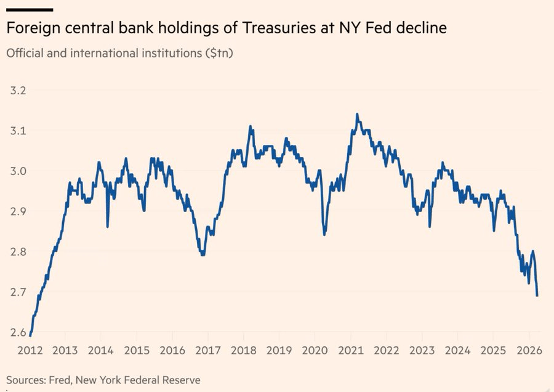
This trend is also evident on a global scale: foreign central banks have reduced their holdings of Treasury bonds to their lowest level since 2012. U.S. bonds are therefore appearing less clearly as a safe haven. Some investors now prefer to purchase bonds from other countries and then convert them into dollars, rather than investing directly in Treasuries.
Admittedly, rising interest rates boost the dollar’s appeal in the short term, which tends to push down the price of gold. But this trend is likely to be temporary. On the one hand, the historical correlation between gold and the U.S. dollar has weakened in recent years. On the other hand, the dollar’s current appreciation largely reflects its strength against emerging-market currencies, whose economies are closely tied to trade with the Gulf monarchies. Furthermore, gold is supported by structural factors that predate the Iran conflict and are likely to persist. Finally, the growing supply of dollars automatically erodes confidence in the currency.
This confidence is no longer eroding solely among countries engaged in a process of de-dollarization or among a growing number of investors: it is also waning among U.S. financial institutions and households, which have been grappling for decades with the erosion of the greenback’s purchasing power. Since the outbreak of the war in Iran, several banks and investment funds have thus implemented withdrawal limits to prevent massive outflows of liquidity and a crisis of confidence — a crisis that is, however, inevitable.
But this time, the Fed — faced with its responsibilities more than ever before — will not be able to intervene as it has in the past without risking the outbreak of a new inflationary crisis, which could permanently undermine the dollar’s credibility. We have been anticipating this scenario for several years, and the new conflict confirms that this is indeed the direction things are heading.
This situation also explains, by a similar mechanism, why many countries — including the United States’ historic allies — have distanced themselves from it. Moreover, following Germany and Italy’s decision to repatriate their gold from the United States, France has just sold the gold it holds in New York in order to keep it on its own soil. For beyond mistrust of the dollar and the American financial system, it is confidence in the world’s leading power that has been undermined. And gold, in this regard, plays not only its historic role as a safe haven, but also as an instrument of sovereignty…
Reproduction, in whole or in part, is authorized as long as it includes all the text hyperlinks and a link back to the original source.
The information contained in this article is for information purposes only and does not constitute investment advice or a recommendation to buy or sell.


