The breakdown of the Dollar Index below its long-term trend, in place since 2008, is not simply a technical accident. It reflects a much deeper change in the way the dollar's role is perceived at the heart of the global financial system.
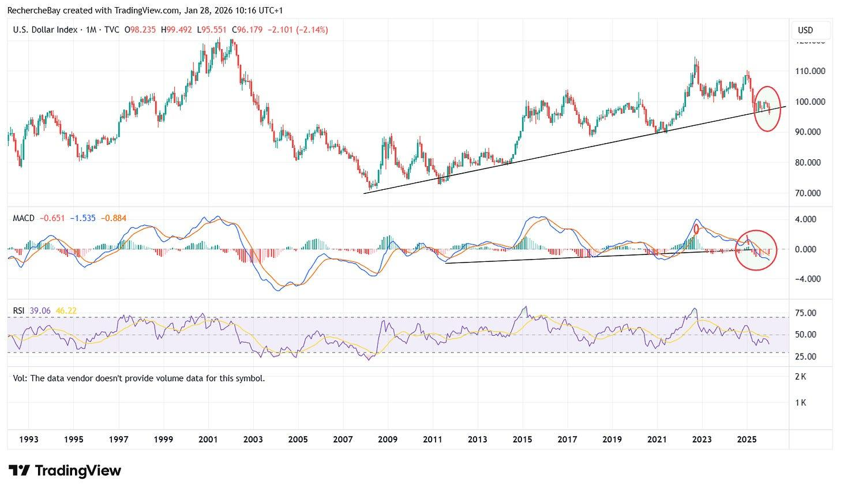
The market is beginning to realize that the dollar is no longer just a tool for US monetary tightening, but could now serve as an adjustment variable to contain a clearly identified point of fragility: the yen and, through it, the entire global carry trade.
This shift accelerated with the New York Fed's announcement that it was prepared to intervene in the foreign exchange market to preserve financial stability. This is far from a trivial signal. When it comes to US intervention in the FX market, this is neither an improvised gesture nor a political symbol, but a well-oiled mechanism operated by the NY Fed's FX desk in coordination with the Treasury via the Exchange Stabilization Fund.
The markets know that these interventions do not necessarily take the form of massive and visible sales of dollars on the spot market, but rather bilateral transactions with primary dealers, currency swaps, or forward transactions capable of influencing market dynamics without leaving any conspicuous traces.
Once this capacity for intervention becomes credible, the very structure of dollar trading is transformed. The implicit message is clear: the strength of the dollar is now politically controlled. Excessive appreciation of the greenback, especially if it increases pressure on the yen, automatically increases the risk of intervention. Conversely, a weaker dollar triggers no reaction.
This asymmetry immediately changes the nature of the long dollar position, which becomes a structurally unfavorable bet. Macro desks and FX traders are not waiting for intervention to materialize: they are selling the dollar in anticipation, because the mere credibility of intervention is enough to break the convexity of the trade.
The link with Japan is decisive. The normalization of Japanese rates, even if gradual, weakens a structure built on several decades of zero rates. The yen carry trade fuels a major part of global markets—from US equities to credit, including certain pockets of private equity. A sudden unwinding of this carry trade would cause a global liquidity shock.
By implicitly accepting a weaker dollar, the Fed is facilitating a relative appreciation of the yen without forcing the Bank of Japan to raise rates aggressively—a scenario that would shatter the Japanese bond market. The dollar thus becomes an external adjustment variable, used to contain a much broader systemic risk.
This interpretation explains why the dollar is no longer fully playing its role as a safe haven. Despite a tense geopolitical environment and still buoyant equity markets, the DXY is weakening. From a technical perspective, the break in the long-term trendline is accompanied by a sharp decline in momentum: the MACD has shifted permanently into negative territory, while the RSI remains below its equilibrium zone. This is therefore not simply a consolidation phase, but a change of regime. The market is not correcting an excess; it is reevaluating a new risk hierarchy.
In this context, the sale of the dollar is neither panic-driven nor aggressive speculation. It is gradual and rational, fueled by the unwinding of positions that are still structurally long on the greenback. The New York Fed's communication acts as a silent trigger: stops are triggered, momentum reverses, and the dollar's weakness becomes self-sustaining.
The decline in the dollar has an immediate effect on the dynamics of volatility. By easing pressure on the yen and, more broadly, on the global financial system as a whole, it buys time. This respite is precisely what the short volatility regime needs to continue. Financial conditions ease, implied tensions dissipate, and equity markets can continue to be bought on the slightest dip.
In this context, US indices, expressed in dollars, are managing to reach new highs—or come close to them—buoyed by the compression of volatility and the persistence of short-selling strategies. But this reading becomes much less flattering as soon as we change currency: expressed in Swiss francs or gold, equity markets are no longer hitting new highs.
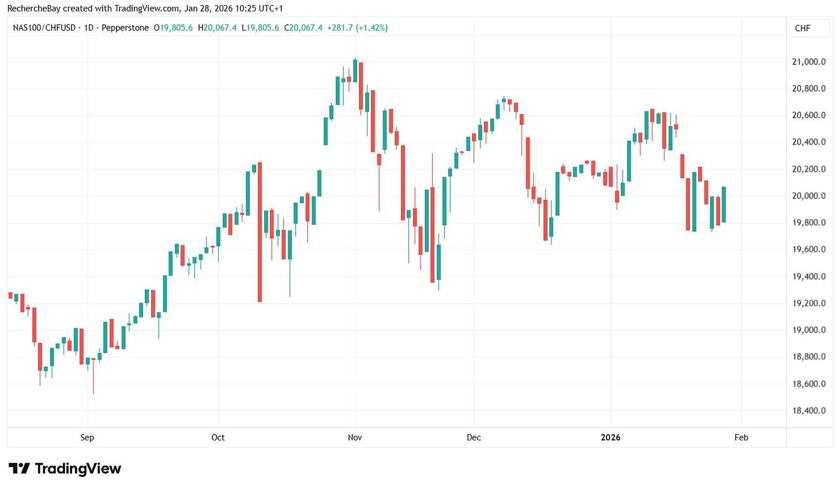
The underperformance is accelerating even relative to gold, not because stocks are falling sharply, but because safe-haven monetary assets are strengthening faster.
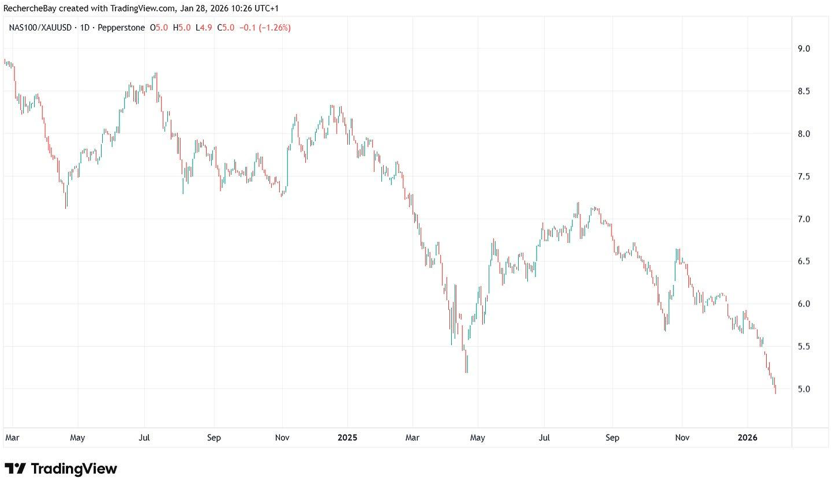
In other words, the market is gaining time in dollars but losing ground in real currency, which is typical of a short-vol regime at the end of a cycle, where the illusion of stability masks a gradual erosion of the purchasing power of risky assets.
This change in monetary and exchange rate regime directly explains the parallel rebound in gold and silver prices. In an environment where the dollar is explicitly used as a stress buffer rather than an instrument of financial discipline, precious metals are regaining their monetary function. A weaker dollar mechanically eases global financial conditions, but more importantly, it signals that the priority of central banks is no longer to defend the currency at all costs, but to preserve the stability of the system.
Gold reacts first, true to its role as the monetary asset par excellence. It incorporates the idea that crisis management now relies less on monetary orthodoxy than on exchange rate adjustments and implicit interventions.
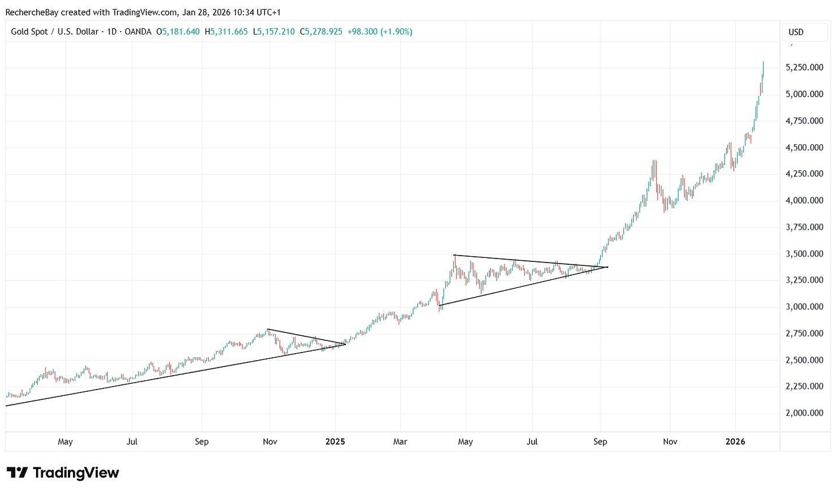
Silver, which is more volatile and more closely linked to speculative flows, then amplifies the movement:
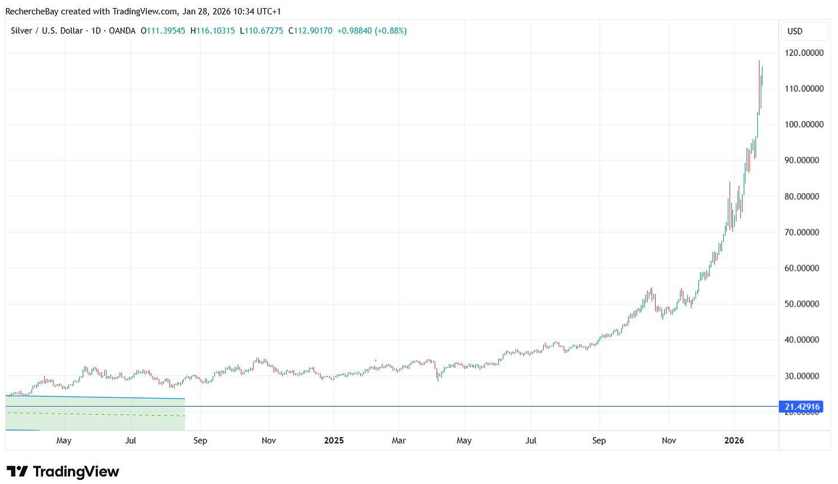
In a context where the dollar is no longer an anchor and the yen is being indirectly defended, precious metals are becoming the natural outlet for doubts about the sustainability of the current exchange rate system.
This rebound is therefore not simply a technical movement or a classic inverse correlation effect with the dollar. It reflects a broader realization: if the dollar can be deliberately weakened to avoid a systemic accident, then the global monetary hierarchy is more fragile than it appears. Gold and silver are not rising against the dollar; they are rising against the idea that monetary stability can still be maintained at no cost.
In this context, the breakdown of the dollar, the renewed credibility of FX interventions, and the rebound in precious metals tell the same story: that of a system seeking to buy time, smooth out shocks, and postpone the most painful adjustments. As is often the case, gold and silver understood this before it was explicitly articulated.
Reproduction, in whole or in part, is authorized as long as it includes all the text hyperlinks and a link back to the original source.
The information contained in this article is for information purposes only and does not constitute investment advice or a recommendation to buy or sell.


