It's funny how gold and bitcoin seem to have swapped roles since the beginning of 2025: usually placid and steadily rising, gold is now skyrocketing like bitcoin in the midst of a bull run, while the digital currency is enjoying a year of calm and stability. And what could be called the “altcoins of gold,” namely silver, platinum, and palladium, are climbing behind the number one precious metal. Meanwhile, altcoins (Ethereum, XRP, Solana, etc.) are looking gloomy. The world has been turned upside down!
One question immediately springs to mind: is gold at risk of experiencing a plunge similar to those that bitcoin regularly suffers during its bear markets? Is a gold crash conceivable? Let's examine this scenario.
Bitcoin evolves in relatively well-identified four-year cycles, punctuated by halving—a mechanism that halves money creation every four years. Except right now. 2025 should have been a good year, but bitcoin has fallen far behind gold. Is this a delay, or are the cycles now completely diluted? It's too early to say. Gold, on the other hand, does not experience sudden breaks in production—around 3,000 tons per year—and is therefore not subject to such cycles.
Let's look at two sharp declines in the gold price in history and see if they are reproducible:
- In 1980: After a period of high inflation during the 1970s, gold was caught off guard by the vigorous policy of the new Fed chairman, Paul Volcker, who raised the key interest rate to 20%! Inflation was eventually defeated and the price of gold fell, before stagnating between $300 and $400 an ounce until the early 2000s. There is no risk of this scenario repeating itself today. On the contrary, Donald Trump has clearly expressed his desire to replace Jerome Powell, whom he blames for keeping interest rates too high. Powell's term ends in May and his successor is expected to adopt a much more accommodative stance. In other words, the risk of a rate hike is virtually zero.
- In 2013: After the surge linked to the subprime crisis of 2008 and then the Greek crisis of 2010-2011, which had reignited doubts about the sustainability of the euro (gold was then close to $2,000 an ounce), the price fell and stagnated until 2018. We are not in that situation today. But that means that if a financial crisis or debt crisis—in the US, Europe, or Japan—were to occur, the price of gold would skyrocket even further. It could only correct if the crisis were resolved without major damage.
Of course, part of the current movement can be explained by the stress caused by Donald Trump and his tariffs, which were announced abruptly, then adjusted downward before being raised again. Will this volatility come to an end? It's hard to say. The fact is that he has few tools at his disposal and clearly likes to use them. We probably shouldn't expect any major changes between now and the midterm elections on November 3, when Congress and one-third of the Senate will be up for re-election. What happens next will depend on his majority and the new political balance of power. So that's the key date to keep in mind.
What stands out most is the rise in volatility: in the space of just fourteen hours, the market capitalization of silver fluctuated by more than $2 trillion—more than the total market capitalization of bitcoin.
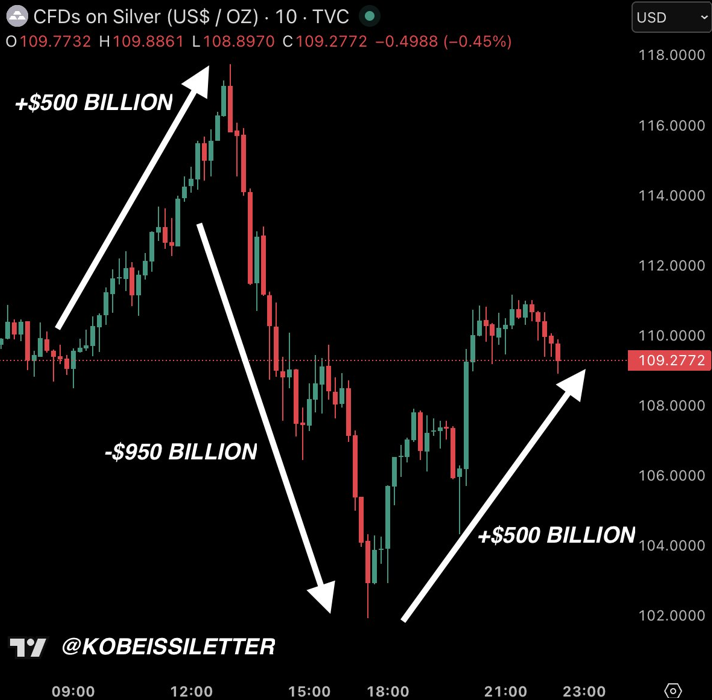
Volatility will remain high—and may even increase—there is little doubt about that. But we don't buy gold for a day or even a year: we buy it for years, sometimes decades, to protect ourselves from monetary dilution that no government is really trying to curb. Gold allows you to see what's coming, get rich, and enjoy the show.
Reproduction, in whole or in part, is authorized as long as it includes all the text hyperlinks and a link back to the original source.
The information contained in this article is for information purposes only and does not constitute investment advice or a recommendation to buy or sell.


