The crack is no longer theoretical; it is becoming a reality — and, as is often the case, the markets are looking the other way.
Apollo Global Management has just capped redemptions on one of its main private credit funds, after redemption requests exceeded 11% of assets under management. In practical terms, investors are only recovering about 45% of the amounts requested. The remainder remains frozen, deferred, or suspended within a structure that was previously presented as a relatively liquid alternative to traditional credit.
The trend is spreading. Ares Management has in turn limited redemptions on a $10.7 billion fund, according to the Financial Times. Cliffwater is facing 14% in redemption requests and is capping them at 7%. Morgan Stanley is receiving 10.9% and capping redemptions at 5%. BlackRock, at 9.3%, is also capped at 5%. Everywhere, the same pattern is emerging: outflows exceeding actual liquidity capacity.
And as liquidity dries up, credit quality is beginning to crack. A flagship fund in the sector, FS KKR Capital Corp., has just been downgraded to speculative grade by Moody’s — a rare event in a market worth nearly $1.8 trillion. This is not merely a technical revision: it is a signal that the deterioration no longer concerns only cash flows, but now the assets themselves.
These redemption limits — often set at around 5% per quarter — are not an anomaly, but the core of the model. They reflect the only liquidity actually available in these funds. Underlying these funds are private, unlisted loans granted over several years, with no deep secondary market. It is impossible to sell quickly without accepting significant discounts. As long as inflows offset outflows, this constraint remains invisible. But as soon as investors want to exit en masse, the reality becomes clear: the promised liquidity was largely artificial.
The link to rising interest rates is central. The entire rise of private credit took place in a world of near-zero rates, where returns of 8–10% seemed exceptional. Today, with risk-free rates having risen again, the arbitrage has shifted.
U.S. 30-year rates are currently rising back above 5%:
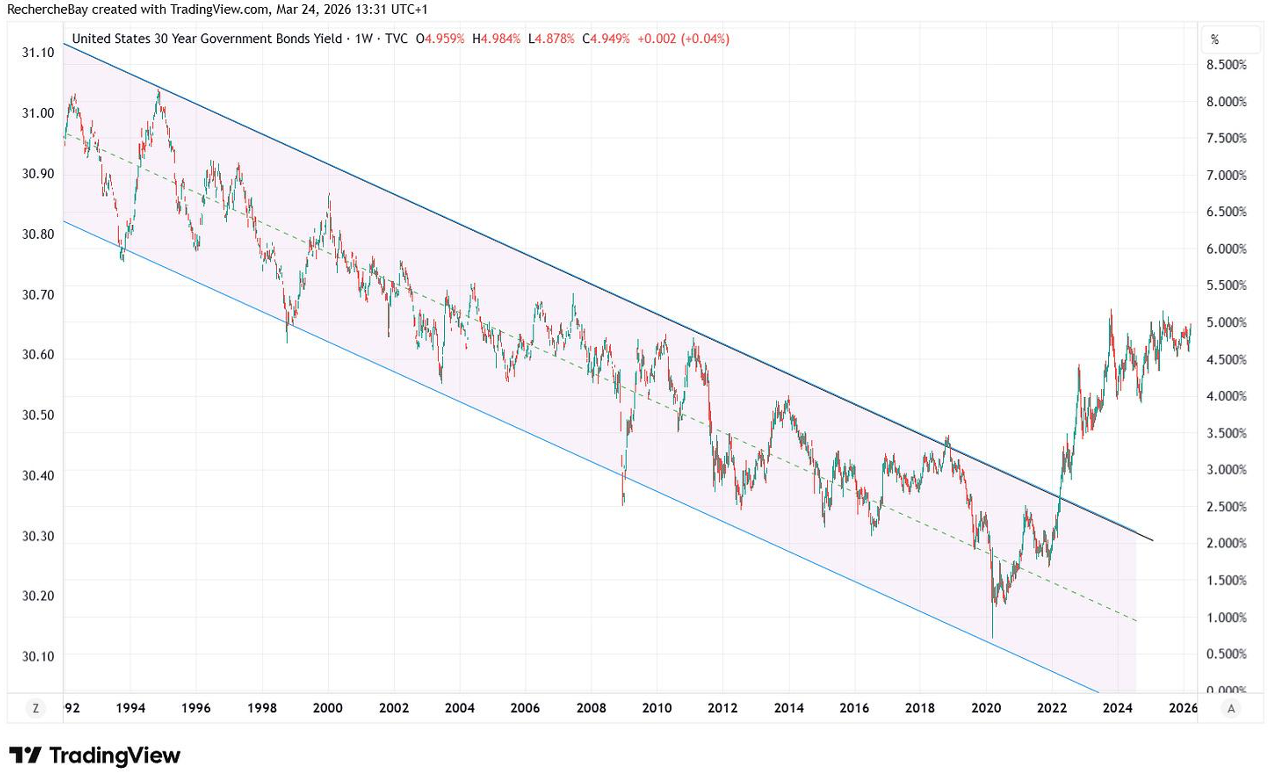
Why remain stuck in an illiquid asset when liquid bonds now offer competitive yields?
But the markets are failing to grasp — as is often the case at this stage of the cycle — the extent of the credit risk that is building up again.
In the short term, attention remains elsewhere. Indices fluctuate in step with oil prices. When crude oil rises, driven by geopolitical developments, equity markets correct. Then, when futures are sold — directly or indirectly via central bank — indices rebound. This back-and-forth dynamic creates the illusion of a market that is digesting the news.
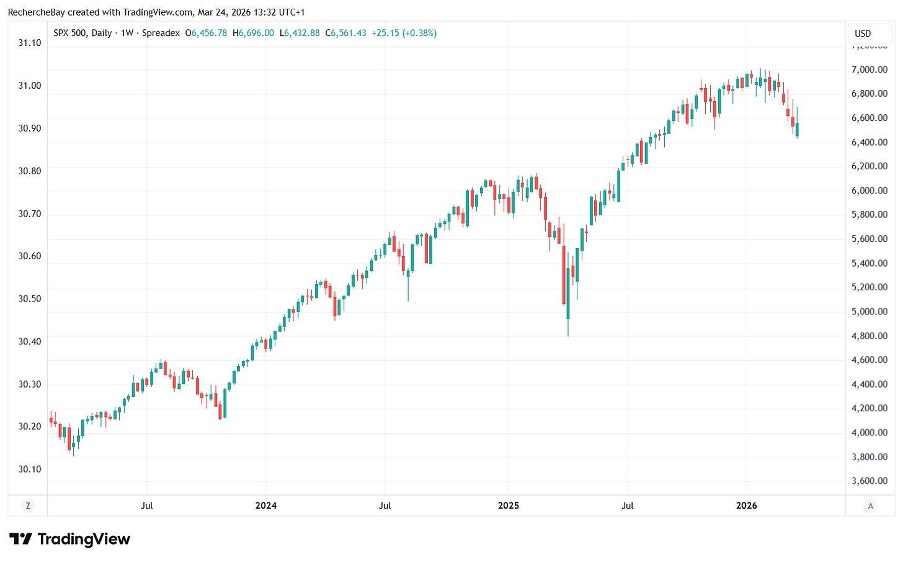
In reality, it’s all just noise.
The markets remain fixated on short-term fluctuations, driven by technical flows and interventions that obscure the signals. Yet the fundamental problem lies elsewhere. It lies in the very structure of credit, in the gradual accumulation of illiquid risks that are now beginning to come to light.
This is always the case in the early stages of a turnaround. The price of liquid assets becomes a smokescreen. It absorbs attention, distracts analysis, and delays awareness. Meanwhile, tension builds where it is least visible: in credit, on balance sheets, and in unlisted structures.
And by the time the market finally looks in the right place, it is usually too late.
Rising rates do more than just alter the relative attractiveness of assets: they also undermine the system’s internal functioning. Existing loans, often structured in an environment of very low cost of capital, become less attractive and see their economic value erode. At the same time, borrowing companies face rising financial costs and more restrictive refinancing terms. The risk of default is rising, slowly but surely.
This dual effect creates structural tension. Investors want to exit just as assets become harder to sell and potentially overvalued. Managers then have only one tool at their disposal: restricting exits to avoid crystallizing losses.
This sets off a slow-motion bank run. There is no visible panic, but a gradual imbalance between available liquidity and actual liquidity. And in a market where valuations rely heavily on internal models, price adjustments are delayed or even avoided.
This disconnect is at the heart of the risk. As long as investors stay put, valuations hold steady. But as soon as they try to exit, it’s no longer prices that adjust — it’s the rules of the game that change.
What is currently at stake goes far beyond the private credit segment alone. It is the entire shadow banking system that is being put to the test in an environment characterized by persistently higher interest rates.
And as is often the case, credit stress never remains confined.
It is already beginning to spread to other segments of the system, including those traditionally viewed as safe havens. The price of gold itself is currently under pressure, not because its fundamentals are being called into question, but due to forced selling.
Several Gulf countries, facing declining energy revenues and the need to defend their currencies’ peg to the dollar, are being forced to draw down part of their reserves. In this context, gold becomes a source of immediate liquidity.
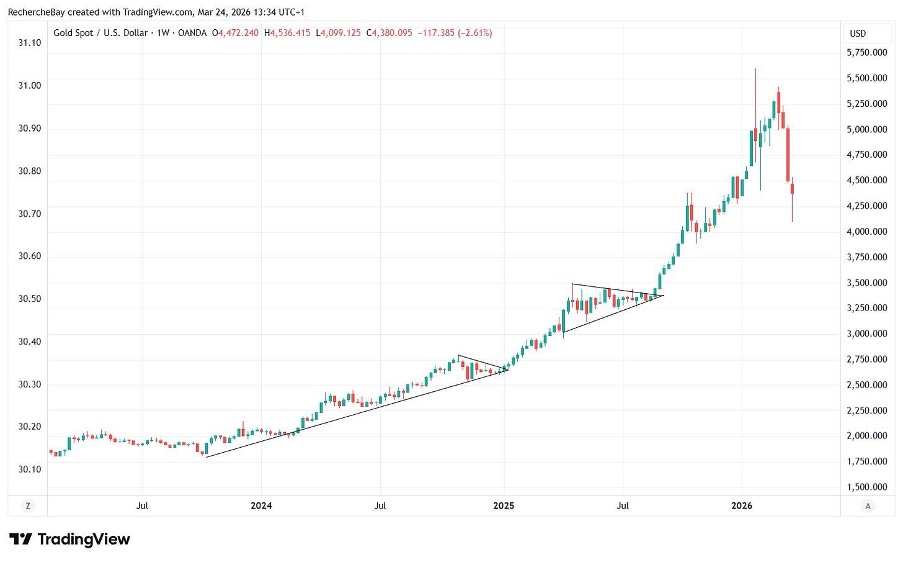
This type of pressure is not structural. It is a short-term adjustment driven by foreign exchange and financing constraints. But it sends a clear signal: when liquidity dries up, everything becomes fair game.
That is precisely what makes this phase so interesting.
For this correction in gold, far from invalidating its thesis, actually reinforces its relevance. It reflects not an intrinsic weakness, but the first tremors of a system forced to liquidate in order to survive. And in an environment where private credit is beginning to crack, where liquidity is rationed, and where valuations remain largely artificial, gold is fully regaining its role as insurance against looming risks.
In other words, these gold sales, which today appear to be an anomaly, could well be an opportunity.
An opportunity for those seeking not to optimize a marginal return, but to protect themselves against the event the market still refuses to fully price in: the bursting of a credit bubble.
Credit is beginning to speak.
The market, however, is still not listening.
Reproduction, in whole or in part, is authorized as long as it includes all the text hyperlinks and a link back to the original source.
The information contained in this article is for information purposes only and does not constitute investment advice or a recommendation to buy or sell.


