Finally, we’ve been waiting a long time for this: here is a major survey on gold held by the French! Released on May 18, it received very little media coverage. Let’s remedy that oversight.
This study was conducted by EY (formerly Ernst & Young) for the Professional Committee for Economic Development in Watchmaking, Jewelry, and Tableware, as well as for the French Union of Jewelry, Goldsmithing, Gemstones, and Pearls (UFBJOP). It is presented by its professional committee, Francéclat.
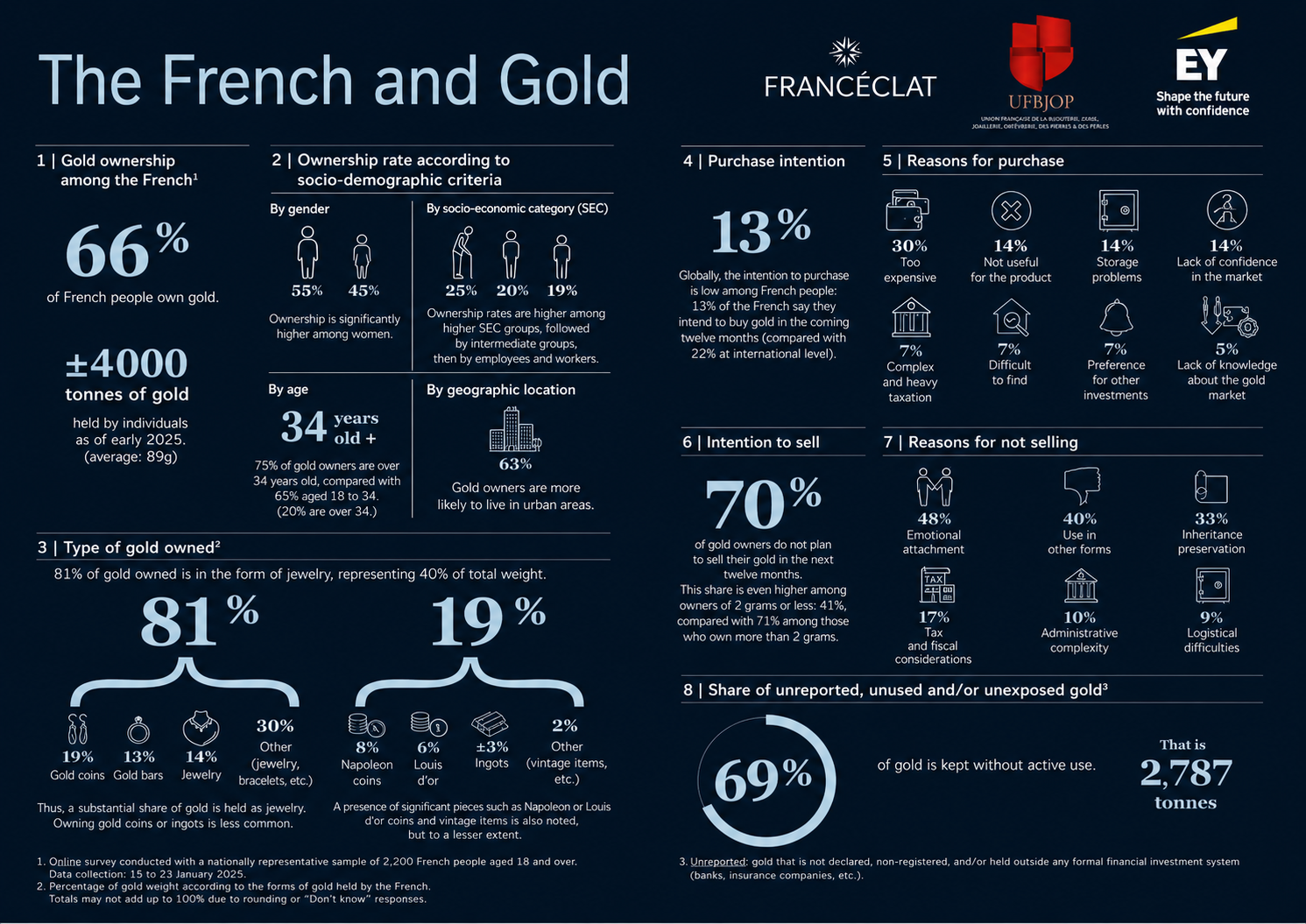
According to this survey of 2,000 individuals representative of the French population, the French are said to hold a colossal stockpile of the yellow metal: 4,000 tons of gold — 4,026 to be exact — which is more than the reserves of the Banque de France, which amount to 2,437 tons! A figure that corresponds to current estimates.
These 4,000 tons fall into two distinct categories:
- Jewelry — wedding bands, rings, necklaces, etc. — which accounts for 81% of the items held, totaling 1,634 tons.
- Investment gold — coins, bars, and paper gold — which accounts for only 19% of the items held but totals 2,392 tons. In our opinion, paper gold should have been accounted for separately, since it isn’t “real” gold… but anyway.
Investment gold thus accounts for 60% of all gold held by individuals, reflecting the French public’s interest in this asset.
Gold ownership is widespread: two-thirds of the French population (66%) own at least one gold item, most often a piece of jewelry. This ownership is, however, highly concentrated, as a minority (12%) hold more than 100 grams of gold, mainly in the form of coins or bars.
But while ownership is high, circulation is limited, since 69% of the stock is considered “inactive,” meaning it is held long-term without being worn, used, or resold. This phenomenon is even more pronounced for jewelry, 76% of which remains stored without being worn. This situation can be explained in part by security concerns, as snatch thefts of gold necklaces have become frequent.
Selling — or donating — thus remains a relatively rare occurrence. Only 22% of gold owners report having sold or donated at least once. Among them, 41% indicate that this transaction took place more than five years ago, a sign of very low turnover.
Louis d’or (53%) and Napoleons (47%) are overwhelmingly passed down from generation to generation. They thus confirm their status as true “family heirlooms.”
The survey highlights three main barriers to selling gold:
- Sentimental attachment, cited by 48% of respondents. Gold, especially when inherited, carries strong emotional and family significance; selling it is often seen as a symbolic break that is difficult to accept.
- Fear of not getting a fair price (40%). Lack of knowledge about market prices and mistrust of certain buying channels fuel hesitation that discourages people from taking action.
- Taxation and its complexity (27%). The flat tax on precious metals is frequently perceived as burdensome and difficult to understand.
As a result of this high level of hoarding and reluctance to sell, the intention to purchase gold remains generally low: 69% of French people do not plan to buy any form of gold.
Moreover, motivations differ significantly depending on the type of gold in question. Jewelry is primarily driven by emotional factors — aesthetic pleasure (29%), special occasions (24%), and gifts (23%) — while investment gold is more about financial and wealth-building considerations, focused on savings (31–38%) and passing it on to future generations (16–19%).
In total, only 13% of French people say they intend to buy gold.
In conclusion, the French love gold and are aware of its value. However, taxation, its complexity, and a lack of understanding of the market are holding back its growth and pushing people toward simple hoarding and passing it down from generation to generation. The myth of “Grandma’s Napoleons” actually has some truth to it!
What would it take to revitalize the gold market? The study does not address this question; so let’s explore a few possibilities:
- Streamline and simplify the tax system. The capital gains tax currently stands at 36.2%, which is a high rate. Admittedly, a 5% annual deduction applies starting in the third year of ownership, leading to a full exemption after 22 years. But prior to the Hollande presidency, this period was only 12 years; a return to that system could be considered. As for the flat tax of 11.5%, which applies when the date of acquisition cannot be proven — a common occurrence for the famous “Napoleons” inherited from family — it too, deserves to be reduced. Ideally, taxation on gold could even be eliminated to make it a true complementary currency. Gold could then be used in transactions whenever the seller and buyer agree, thereby stimulating the economy. At least, that is the idea I advocate — I may be dreaming, but I stand by it.
- Better inform savers. Few French people know, for example, that the purchase of gold jewelry is subject to 20% VAT, unlike investment gold, which is exempt. A better understanding of these mechanisms would undoubtedly lead to more informed choices.
- Re-establish a gold market on the Paris Stock Exchange. This would provide a national benchmark rather than relying exclusively on the price per ounce in dollars, a unit that is often abstract to the general public. A gold market quoted daily by the media would also serve as a tremendous showcase.
French gold is a dormant treasure, an underutilized resource, and an overlooked investment opportunity. Unlocking its potential could, in its own way, contribute to the country’s economic recovery!
Reproduction, in whole or in part, is authorized as long as it includes all the text hyperlinks and a link back to the original source.
The information contained in this article is for information purposes only and does not constitute investment advice or a recommendation to buy or sell.


