A two-week ceasefire has just been signed between the United States and Iran. The agreement appears fragile — we’ll have to wait and see — and the risk of a resurgence in inflation remains, particularly in Europe.
In a statement released on April 5, OPEC+ warned that repairing the energy infrastructure damaged in recent attacks would be “costly” and take “a long time,” which could have a lasting impact on global oil supplies. Even though several countries have announced an increase in their production quotas, the impact will be limited.
For its part, the International Energy Agency (IEA) emphasizes, in an analysis dated March 21, that disruptions to oil and gas flows through the Strait of Hormuz, as well as attacks on energy infrastructure in the region, constitute “the greatest threat to global energy security in history.” In 2025, approximately 25% of global maritime oil trade passed through this strategic waterway, for which alternatives remain limited. Although emergency reserves have been mobilized, their effect can only be temporary. Its Executive Director, Fatih Birol, also told: “The current crisis is more severe than those of 1973, 1979, and 2022 combined.”
Since the start of the conflict, oil and natural gas prices have risen significantly, by around 60%. Crude oil and petroleum product flows through the Strait of Hormuz have dropped from approximately 20 million barrels per day before the war to near-zero levels today. LNG production in the Gulf region has also been heavily affected: the Ras Laffan facility in Qatar, the world’s largest liquefaction site, has been shut down since the March 2 attack. This situation comes at a time when European countries must begin rebuilding their stockpiles in preparation for next winter.
Other key commodities are also affected, particularly fertilizers: more than 30% of global urea trade passes through the strait, as well as about 20% of ammonia and phosphate. Disruptions could intensify, as some countries rely on imported LNG to power their fertilizer plants. The risk of soaring food prices is looming, not to mention shortages. Furthermore, the Gulf region accounts for nearly 8% of global aluminum production, while about half of the global maritime trade in sulfur also passes through the strait. Sulfuric acid is a key input not only for fertilizers and the chemical industry, but also for oil refining and the processing of essential metals such as copper, nickel, and zinc.
Energy commodity prices reacted positively to the ceasefire by falling, but a return to normal will take time: according to the director general of IATA, the supply of jet fuel is not expected to normalize for “several months.”
In short, inflation will pick up again, starting with energy — oil and LNG — before spreading to the entire economy, particularly food prices, an effect exacerbated by rising fertilizer costs. Since energy and food are two categories of spending that are difficult to postpone or reduce, the loss of purchasing power will be significant. Europe appears particularly vulnerable due to its energy dependence — exacerbated by sanctions against Russia and the refusal to exploit its shale gas — unlike the United States, which is largely self-sufficient. As Frank Elderson, a member of the ECB’s Executive Board, lamented in a blog post: “Europe’s dependence on foreign energy makes it tougher for the ECB to keep prices stable.” Will inflation exceed the levels reached after the Covid crisis? That will depend on whether central banks step in and start printing money. In the event of an economic slowdown and widening budget deficits, this scenario is highly plausible. We will need to monitor the decisions of the Fed and the ECB, as inflation stemming from the real economy, amplified by money creation, would constitute a particularly explosive cocktail.
Is gold anticipating a return of inflation? Everything points to it. According to The Kobeissi Letter, gold has recently become the world’s top asset by trading volume, surpassing U.S. debt and major currencies:
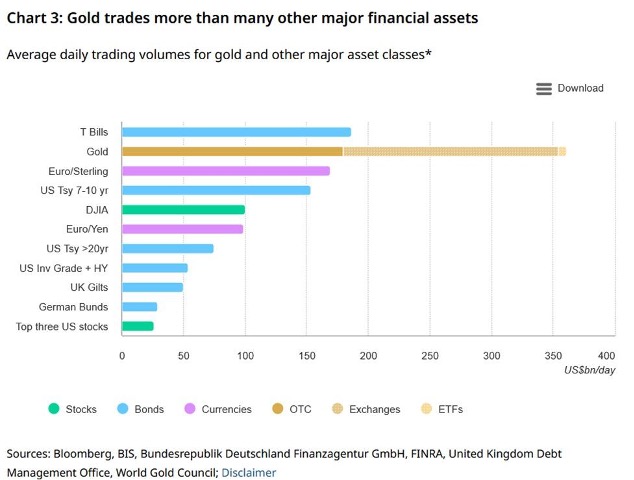
Beyond the fluctuations in the price of gold, this data is crucial. It’s hard not to see this as a sign.
Reproduction, in whole or in part, is authorized as long as it includes all the text hyperlinks and a link back to the original source.
The information contained in this article is for information purposes only and does not constitute investment advice or a recommendation to buy or sell.


