Silver has just crossed a symbolic threshold – more than $60 to $61 per ounce for the first time in history – after jumping 100 to 110% since the beginning of 2025, its best performance since the crazy year of 1979.
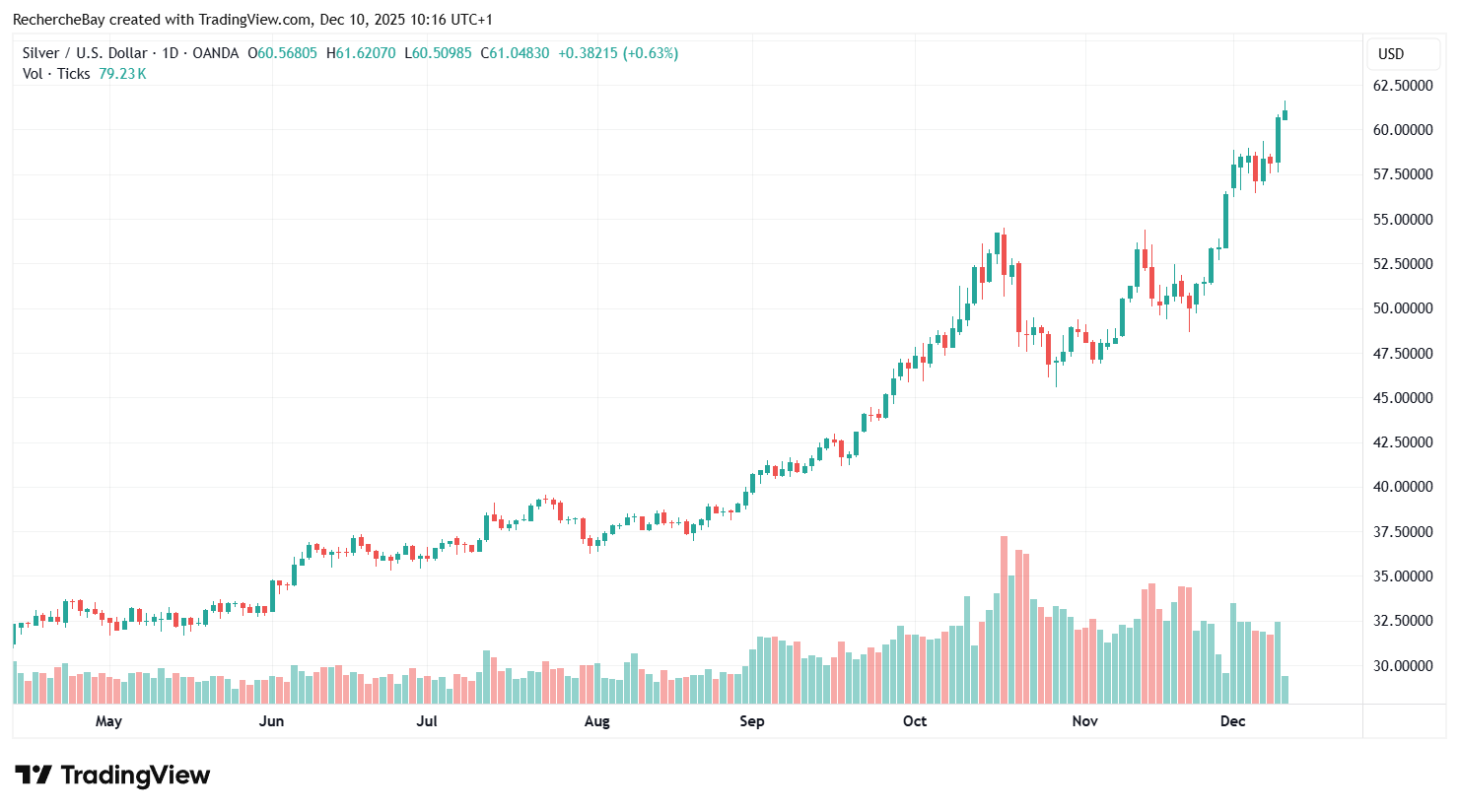
The movement appears “explosive” in the short term, but it is actually part of a dynamic that we have been following step by step for several years on Goldbroker.com:
On December 13, 2024, I wrote that the rise in EFP premiums on March contracts signaled abnormal tension between COMEX and the London physical market. I pointed out that this spread, which is supposed to simply reflect storage and financing costs, had slipped to more than a dollar per ounce, putting pressure on bullion banks, which are structurally short on these EFPs. I also highlighted a point that had gone unnoticed at the time: the risk that the tariffs announced by the Trump administration on metal imports (including silver bars refined in China) would disrupt the logistics of physical delivery, at a time when demand for photovoltaics and physical gold from central banks was exploding, amid total indifference from Western investors. Everything was already in place: a weakened supply chain, an oversized paper market, and a context of emerging deficits.
On March 20, 2025, silver had just broken a 12-year trend and was beginning to outperform the famous 60/40 portfolio, as gold had done in 2024. I wrote at the time that the real break would not come from a “trade,” but from a gradual loss of confidence in the paper market. The COMEX/LBMA tandem was increasingly shifting towards cash settlements rather than metal, EFPs were no longer systematically leading to deliveries, and physical deficits were accumulating: more than 230 million ounces in 2022, around 260 million in 2023 according to the Silver Institute.
London stocks were declining, the LBMA free float fell below a critical threshold, and 3-month silver lease rates exceeded levels that, historically, had always been followed by a 20 to 50% increase within 6 to 12 months. What I was describing at the time was a pricing system based on paper leverage that was increasingly disconnected from the actual metal and vulnerable to the slightest shock of confidence.
On July 18, 2025, when I mentioned a “boiling” silver market, we were already in the thick of the current battle. Within an hour, 483 million ounces had been sold short on COMEX in an attempt to crush a breakout above $37.50... A maneuver that failed, leaving short sellers trapped and at a loss amid accelerated physical withdrawals and suddenly very expensive EFPs. At the same time, the United States was tightening its mineral sovereignty doctrine by imposing punitive taxes on imported copper, signaling de facto that certain metals – including silver – would gradually be treated as strategic resources.
The rise in premiums in New York, the erosion of stocks, the rise of silver-backed ETFs, and five consecutive years of structural deficits were already pointing to the situation we are experiencing today: a market where finance is trying to slow down a re-rating imposed by physical reality.
On October 17, 2025, I described what I called the “dislocation” of the money market. For the first time since 1980, spot prices were consistently higher than futures prices, the curve was shifting into sharp backwardation, metal borrowing costs in London were skyrocketing, and the interbank physical market was grinding to a halt. In that same newsletter, I linked this disruption to the fiscal dominance that now prevails over US monetary policy – the “fiscal QE” that forces the Treasury to live from auction to auction – and to the fact that physical metals are immune to this widespread manipulation of risk pricing. Silver was then beginning to fully play its role as the canary in the coal mine: where stock indices can be supported by derivatives and bitcoin relies on synthetic liquidity, the silver market was a stark reminder of the scarcity of the real world.
The movement observed in recent weeks has not come out of nowhere. It is the result of dynamics that we have been describing for a long time, combined with a series of very concrete catalysts. The fall in Shanghai stocks to a nearly nine-year low, against a backdrop of massive exports of Chinese silver to London, is drying up one of the world's main hubs while simultaneously tightening the domestic market.

Liquidity in London is already fragile: leasing rates remain high, borrowing costs continue to climb, confirming the warning signs identified as early as 2024-2025 by TD Securities studies on episodes of extreme stress. At the same time, significant volumes of metal have been drained to the United States, where the anticipation of new tariffs under the Trump administration, combined with the classification of silver as a “critical mineral,” is prompting manufacturers and investors to secure their upstream supply.
This geographical shift has been accompanied by a real surge in demand. India is stepping up its purchases of silver, both as a savings asset and as collateral for certain types of credit, which is putting further pressure on physical supplies. Metal-backed ETFs are now enjoying months of positive flows – a tenth monthly increase is on the horizon – while call volumes on the main ETF (SLV type) have exploded, a sign that Western retail investors, long absent, are finally beginning to reposition themselves. Against this backdrop, the Fed, locked into a regime of fiscal dominance, is preparing to lower rates again to relieve a debt-saturated system: the mere anticipation of this pivot automatically makes non-interest-bearing assets such as gold, and even more so silver, more attractive than bonds, whose future purchasing power appears increasingly doubtful.
Finally, there is the industrial component, which is no longer just a backdrop. Silver has become a critical metal for solar energy, power electronics, and certain applications related to AI and semiconductors. The fourth quarter is traditionally the peak season for photovoltaic installations: this seasonality is fully in play this year, in a context where mining supply remains inelastic, since 70 to 80% of global production comes from copper, lead, or zinc mines for which silver is only a by-product.
When industrial and investment demand overlap, the supply response capacity becomes almost zero in the short term. Recent VAT changes in China, which penalize certain gold flows, have redirected part of the retail customer base towards silver, reinforcing this shift from precious metals to the “metal of two worlds,” both monetary and industrial.
The result of this accumulation of forces is clear to see: silver above $60 an ounce, annual performance exceeding 100%, a gold/silver ratio back to its lowest level since 2021, and a bitcoin/silver ratio back to its 2023 levels.
The movement is spectacular, but it does not necessarily mark the end of the story. In real terms – that is, adjusted for inflation – the silver price remains below the 1980 highs, which would be equivalent to $150 to $170 per ounce today according to the calculation methods used at the time.
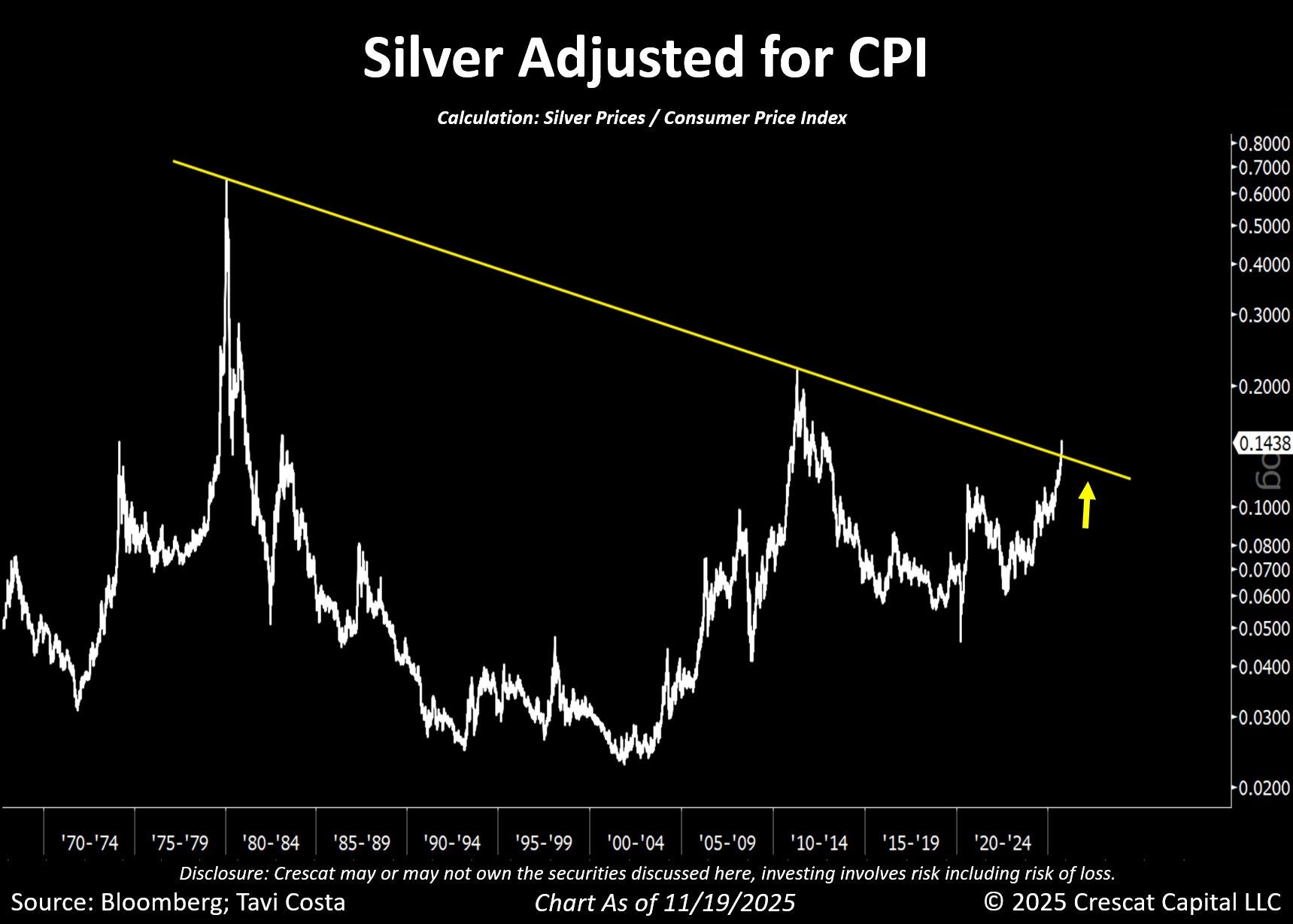
Conversely, the market structure is much healthier today than it was in the Hunt brothers' era: we are not witnessing an isolated speculative cornering attempt, but rather the gradual re-rating of an undervalued asset caught between a chronic physical deficit, a geopolitical reshaping of flows, and the loss of credibility of a financial system that is only holding together thanks to artificial risk compression.
In December 2024, then in March, July, and October 2025, I attempted to show that the challenge was not to predict the exact next price, but to understand the silent fractures between paper and reality. The nominal record that silver has just set is only the tip of the iceberg. As long as demand for physical metal remains strong in Asia, India, among certain Western manufacturers and, increasingly, among savers, and as long as the pricing system continues to be based on delivery promises that far exceed available stocks, volatility will remain extreme... but the underlying trend will continue to favor metal, not paper.
Reproduction, in whole or in part, is authorized as long as it includes all the text hyperlinks and a link back to the original source.
The information contained in this article is for information purposes only and does not constitute investment advice or a recommendation to buy or sell.


